You have found an overseas salon offering a colour, perm or treatment at an attractive…
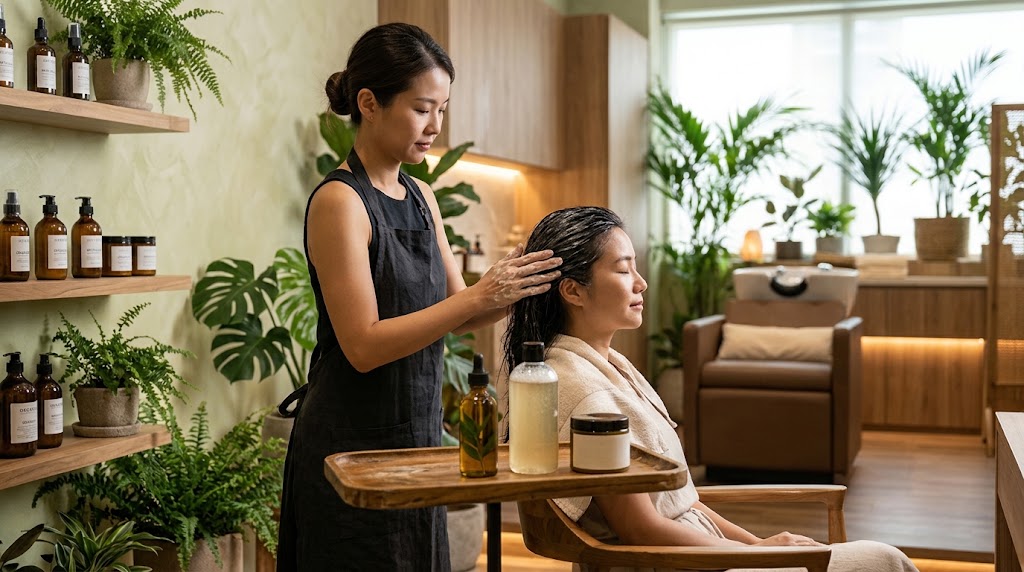
Oily Roots and Dry Ends? Do you Need Scalp Shampoo, scalp Treatment or Hair Treatment?
Understand what each area needs before choosing products and salon services.
Your roots feel greasy and flat, but your ends are rough and difficult to comb. You want cleaner roots and softer hair, yet you are unsure what to choose. Would a different shampoo help, or do you need a salon scalp treatment, a hair treatment or both?
Start by considering your scalp and hair lengths separately. Suitable shampoo may manage some concerns at home, while dry or fragile lengths may need different products. A salon treatment should have a clear reason to add something useful.
This guide helps you understand your options and make a more informed decision about suitable products and a salon. Use the examples to describe your concerns, then ask your hair stylist to double-check your scalp and hair condition.
1. What are you noticing—and where?
Think about how your scalp and hair feel between salon visits.
| What you notice | Your starting point |
|---|---|
| Oily roots, but manageable lengths. | Review scalp shampoo, washing frequency and products applied near the roots. |
| Heavy roots after repeated dry shampoo or styling-product use. | Review how thoroughly products are washed out. |
| Dry or tangled lengths, but a comfortable scalp. | Discuss conditioner or a home hair treatment for the lengths. |
| Oily roots together with dry or fragile ends. | Assess the scalp and lengths separately before choosing a combined service. |
| Persistent flakes, itching, redness or soreness. | Seek advice rather than assuming you need a stronger cleanse or exfoliation. |
| More hair falling out than usual or visible thinning. | Seek medical assessment for suspected hair loss. |
These observations are starting points, not diagnoses. You may have more than one concern.
When should you seek advice first?
Flakes are not automatically product buildup. Information from the National Skin Centre describes several scalp conditions and product reactions that can cause itching, redness and scales. Persistent symptoms need assessment rather than repeated exfoliation. HealthHub and National Skin Centre: Scalp conditions
Oiliness alone does not establish the cause of hair loss. If more hair is falling out than usual or your hair looks thinner, seek medical advice. NUH: Hair Loss
2. For oily roots, review your scalp shampoo first
For excess oil or product residue, suitable shampoo and an appropriate washing routine may manage the concern. A salon scalp treatment is not automatically necessary.
Explain what you currently use, how often you wash and how soon your roots feel oily again. Mention dry shampoo, styling products and any tightness or irritation after washing.
The aim is effective cleansing that leaves your scalp comfortable—not the strongest possible shampoo. HealthHub recommends regular washing with a gentle shampoo to help limit accumulated oil and dead skin cells. HealthHub: Dandruff
Dry shampoo absorbs oil but does not replace washing with shampoo and water. Review how often you use it and how you remove it before assuming heavy roots require a salon scalp treatment.
What if you also have dandruff?
A general scalp shampoo or exfoliating shampoo is not automatically an anti-dandruff treatment. Ask a pharmacist whether an appropriate anti-dandruff shampoo is suitable. Seek further advice if symptoms persist or worsen. HealthHub: Dandruff
3. For dry ends, assess the lengths separately
Oily roots do not mean your ends should go without conditioning.
Natural oil is produced at the scalp. Your lengths may still feel dry because of their texture, previous chemical services, heated styling or environmental exposure.
Ask your hair stylist to check what concerns you most:
- Roughness and tangling: Discuss suitable conditioner or a home hair treatment for softness and easier combing.
- Hair breaking during brushing or styling: Ask whether strengthening is appropriate.
- Both concerns: Ask whether one hair treatment can provide conditioning and strengthening benefits.
Explain whether richer products leave your hair flat. The formula, amount and application should suit your hair condition and preferred finish.
CNA Lifestyle’s reporting highlights the importance of matching cleansing to scalp condition while avoiding unnecessary drying of the lengths. Understanding the scalp and hair’s different needs
4. Explain your history, environment and daily routine
These details help your hair stylist interpret what you notice.
- Previous services: Mention colouring, bleaching, perming or rebonding, especially when the same lengths have had several services.
- Products and sensitivities: Explain what you apply near the roots and through the lengths, what has helped and any previous reactions. Mention prescribed scalp products and continue following your healthcare professional’s instructions.
- Exercise and warm weather: Sweat can leave roots damp and hair looking flatter. That feeling alone does not establish excessive oil production.
- Humidity: Frizz or difficulty styling does not, by itself, prove damage.
- Sun exposure, swimming and travel: Mention whether dryness or tangling followed more time in the sun, pool or sea swimming, or a holiday in a different climate. Do not assume the climate explains persistent scalp symptoms.
For example:
“My roots feel greasy by evening, but my bleached ends are difficult to detangle. I exercise regularly and use dry shampoo between washes. Could you check what each area needs?”
5. Would a salon treatment provide an additional benefit?
After reviewing your condition, products and routine, ask your hair stylist what a salon treatment would add.
| Salon option | Intended purpose | The question to ask |
|---|---|---|
| Scalp treatment | Depending on the formula, targeted cleansing, exfoliation or hydration. | What would this add to my regular scalp shampoo? |
| Hydrating hair treatment | Conditioning dry lengths for softness and easier detangling. | Would this help the difficulty I still have with my ends? |
| Strengthening hair treatment | Helping improve strength and reduce breakage, where supported by the formula. | Have you observed breakage, and how would this formula help? |
| Combined scalp and hair treatment | Addressing different needs in both areas. | What does each part contribute, and are both useful now? |
A stronger cleanse is not automatically better, and a scalp treatment should not be expected to resolve fragile lengths. Two concerns do not automatically require two intensive services.
6. Confirm the recommendation, then review the result
Before deciding, make sure you understand:
- Suitability: What has your hair stylist observed?
- Expected improvement: What should feel or behave differently?
- Inclusions and price: What products and steps are involved, how long will it take and what is the full cost?
- Maintenance: What should you use at home, and when should you review the result?
If a scalp camera is used, ask what the images show. Images alone do not establish a scalp diagnosis or the cause of hair loss.
After changing products or having a salon treatment, review each area separately. Does your scalp feel comfortably clean without irritation? Are the lengths softer and easier to comb without feeling heavy?
A scalp shampoo or scalp treatment does not permanently stop natural oil production. Agree on further appointments according to your response and needs rather than assuming everyone requires the same schedule.
Considering Aveda options at Team Salon
Once your scalp and lengths have been assessed, ask which products or salon treatments match the recommendation.
For shampoo, Aveda’s Scalp Solutions Balancing Shampoo gently cleanses to help remove excess oil and impurities. Invati Ultra Advanced Exfoliating Shampoo Light gently exfoliates and removes oil and environmental residue; Aveda identifies it for fine-to-medium thinning hair with a normal-to-oily scalp. Confirm suitability and local availability. Scalp Solutions Balancing Shampoo, Invati Ultra Advanced Light
Invati’s reduction-in-hair-loss claim relates to breakage after using its complete four-step system. It does not establish that shampoo alone treats hair loss from the roots.
Aveda’s professional menu also includes scalp treatments powered by Scalp Solutions, hydrating hair treatments powered by Nutriplenish, and strengthening hair treatments powered by Botanical Repair. Ask which service is available locally and what each part would add. Aveda professional treatments
Team Salon lists Aveda Botanical Scalp Therapy, Aveda Botanical Hair Therapy and Aveda Botanical Hair + Scalp Therapy. Ask your hair stylist to double-check your condition and explain the suitable options. View the price guide or book an appointment at one of Team Salon’s six Singapore locations.
Questions and answers
Should I skip conditioner because my roots are oily?
Not automatically. Your lengths may still need conditioning. Discuss the formula and where to apply it, especially if your roots are easily weighed down.
Should I wash less often to make my scalp less oily?
Do not assume reducing washing will solve oiliness. Discuss a frequency suited to your scalp, activities and products. Review the shampoo and method if washing leaves your scalp uncomfortable or your lengths dry.
Does every flaky scalp need exfoliation?
No. Flakes have different possible causes. Avoid scrubbing an irritated scalp and seek advice for persistent flakes, significant itching, redness or swelling.
Will a combined scalp and hair treatment leave my hair flat?
The result depends on the formulas, amounts and application. Explain that you want conditioned ends while retaining volume, and ask what finish to expect.
Can scalp shampoo replace a salon scalp treatment?
For some concerns, suitable shampoo and an appropriate washing routine may be sufficient. Ask your hair stylist what additional benefit a salon scalp treatment would provide before deciding whether you need it.
This guide helps you describe your concerns; it does not diagnose scalp conditions or hair loss. Seek medical advice for persistent scalp symptoms or suspected hair loss, including sudden, patchy, progressing or advanced hair loss.

Related Posts